

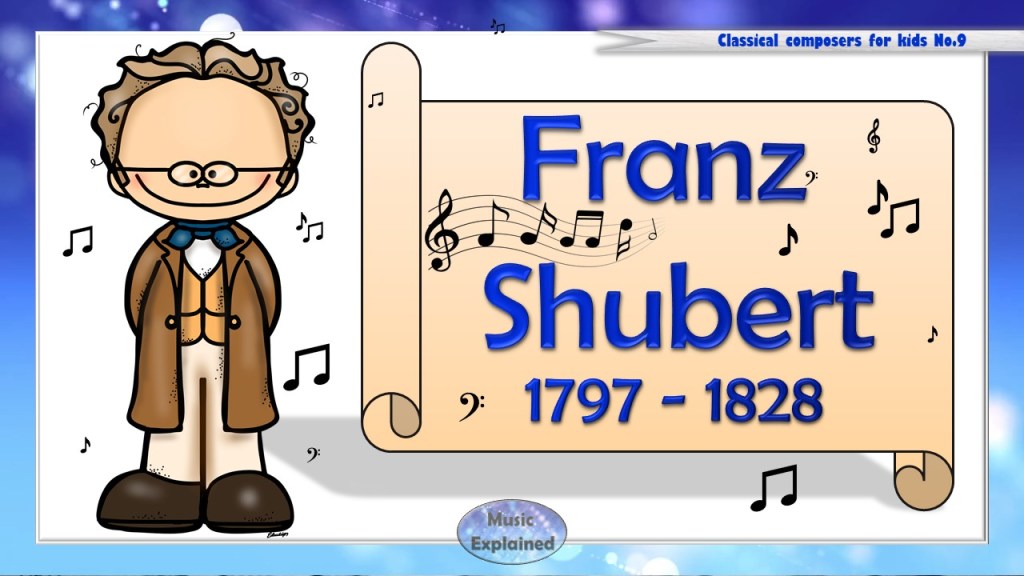
… a composer from Austria who lived during the
“Late Classical-Early Romantic”
period of music…
Shubert was born in Austria in 1797.
His father was a schoolmaster and played violin and cello.
Franz’s father taught him to play the violin, his older brother, Ignaz taught him piano.
Franz was such an eager student that his teachers had trouble keeping ahead of him. He seemed to already know what they were going to say.
When he was 11, Shubert’s wonderful voice earned him admission into the Imperial Choir where court singers were trained.
As a good student, he soon became the first violinist of the orchestra and was even allowed to conduct.
He studied avidly the works of Mozart and Beethoven
Shubert began composing under the direction of his teacher: Antonio Salieri.
Shubert was a very friendly, happy, and likable person. He had many friends. They gathered in the evenings to hear Shubert play his music and to enjoy hearing some of the best singers perform his songs.
Shubert liked people and they liked him. He had little money, but great wealth in his many friends. These friends, most of high social standing, were lawyers, businessmen, painters, government officials, and poets.
They looked after his needs, often giving him money, food, and a place to stay. In the evenings they would gather in a home to hear Shubert’s music.”
These evening parties became known as “Schubertiades”. Often the most famous singers of the day would come to sing his songs while he accompanied them. Everyone had a good time listening, laughing, playing games, and dancing. All the friends had nicknames; Shubert was called “Tubby” because he was short and rather round!
Shubert composed very quickly. Once when he was visiting his friend in the hospital, he wrote an entire composition in the three hours he was there. Another time while having dinner with his friends and having just heard one of them read a poem from Shakespeare, an idea for a melody came to him. Not having any music paper, he wrote the music on the back of the bill.
Besides having written over 600 songs, Shubert composed piano and choral music. He wrote 8 symphonies; the best known is the “Unfinished” Symphony. It is called the unfinished because it contains two movements rather than the usual four.
Shubert was deeply affected by the death of his idol, Beethoven in 1827 and was a torchbearer at his funeral.
Unfortunately, he died a few months later at the age of 31. He was buried close to Beethoven’s grave in the Waring cemetery.
Watch the video on my YouTube channel and enjoy the beautiful classical music!
 Music Explained